

- Out-of-Stock


Sea foam is generally known as the "white goddess" and admirers of her especially emphasize her rendition. It is composed of hydrated magnesium silicate (scientifically referred to as sepiolite) found in Turkey and Tanzania.
Its origin is uncertain, but it is assumed that the calcareous water of the rivers has eroded the magnesian stones and deposited the mud formed. Possible geological changes would have determined the change in the course of the river, leaving behind, at a depth between forty and eighty meters, alluvial deposits that would then be pressed into blocks under the pressure exerted by the tectonic masses above.
While there are countless legends on the date of birth of the first pipe made from this particularly light material, on the other hand it is certain that the first European sea foam pipes were manufactured in Hungary and imported by some aristocrats in Vienna, where a sea foam processing center was developed.
Around 1870 over two hundred companies located in the Austrian capital were producing hydrated magnesium silicate pipes and the term "Vienna foam" was introduced into the pipe literature.
The best sea foam used in the processing of pipes is the block one from Turkey, extracted mainly in the region surrounding Eskisehir.
The material originating in Tanzania is geologically much younger than the Turkish one and does not give the same yield and does not even have the same truly white color as the Turkish one.
For low-priced pipes, pressed foam is also used, made up of foam waste held together by the pressure exerted and the binder.
There is a further lower quality which consists of bulk sea foam which also consists of waste, which is ground into a pulp which, once water, potassium silicate and potassium salts have been added, is boiled for processing.
Block sea foam pipes are usually made on a lathe.
At first the blocks are cut to the right size, softened in water and finally, still wet, turned and drilled and often carvings or ornaments are applied to them.
While in the past the turned heads were dipped, or carved in whale white, today they are dipped instead in the lightened white wax.
Foam pipes have won over many smokers because they do not need to be broken in, do not suffer burns and allow the tobacco to retain its aroma.
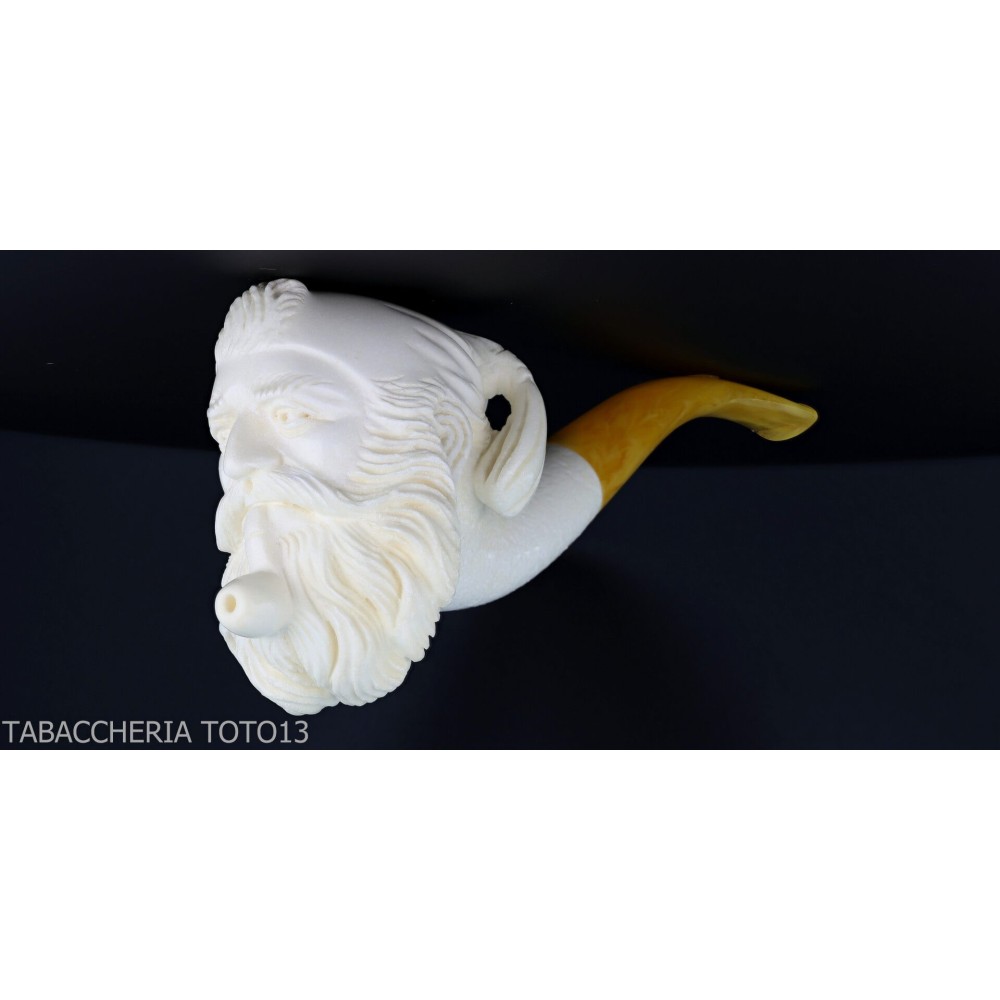
What you see here is an early 1990s hand-carved sea foam pipe depicting a bearded man smoking a pipe.
The subject of this sea foam sculpture pipe is a bearded Ottoman smoking a pipe.
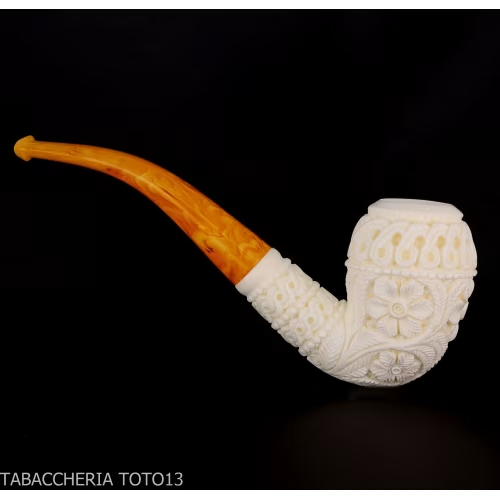
Each sea foam pipe is a unique and unrepeatable piece and the photos you see portray this exclusive pipe, the same, once purchased, will be removed from the catalog.
If you need more detailed photos, we will be happy to send them to you.
1) width 170 mm
2) height 75 mm
3) depth 49 mm
4) chimney diameter 20 mm
5) fireplace depth 46 mm
Features:
Mouthpiece in light amber marbled straw yellow iuvelite.
6 mm diameter, Teflon reinforcement, no filter.
Weight: 78 grams
Shape: Freehand curved carved, Bent billiard.
Finish: decorated glossy white sea foam.
Markings: -

Data sheet
You might also like